


National reports
- Albania
- Austria
- Belgium
- Bulgaria
- Croatia
- Cyprus
- Czech Republic
- Denmark
- Estonia
- Finland
- France
- Germany
- Greece
- Hungary
- Italy
- Latvia
- Lithuania
- Luxembourg - Administrative Court
- Malta
- Montenegro
- Netherlands
- Norway
- Poland
- Portugal
- Romania - High Court of Cassation and Justice
- Romania - Legislative Council
- Serbia
- Slovakia
- Slovenia
- Spain
- Sweden
- Switzerland
- Türkiye
- Ukraine
- United Kingdom
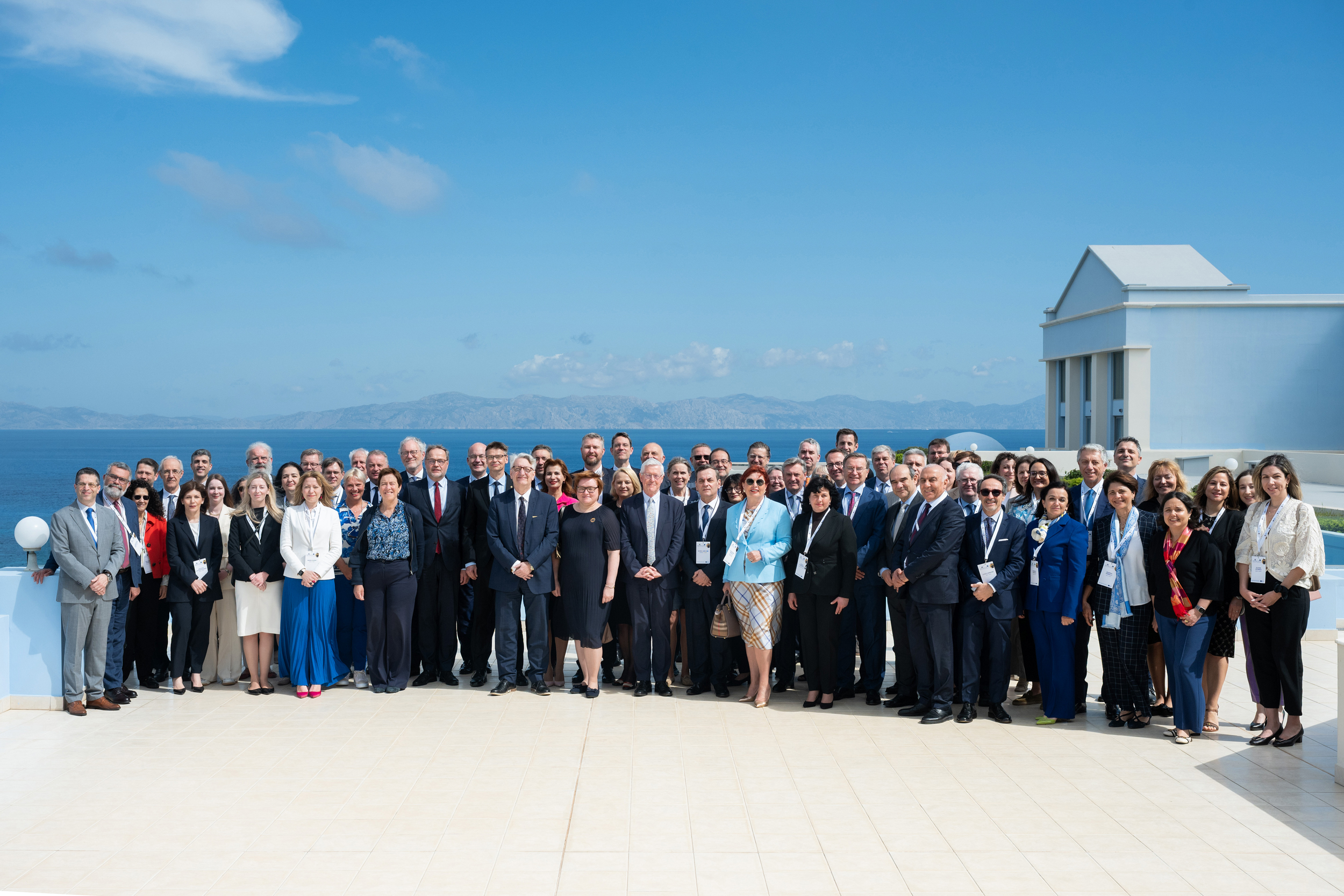
On 15-16 May 2026, in Rhodes, the Hellenic Council of State, in collaboration with ACA-Europe, organised a seminar entitled “New Elements in the Organisation and Functioning of Public Administration and Administrative Justice”. The seminar began with a welcome speech by the President of the Hellenic Council of State, Michail Pikramenos, who thanked the participants for their responses to the questionnaire and delivered introductory remarks on the seminar topic.
Working Session I, chaired by Lord Hamblen, judge at the Supreme Court of the United Kingdom, was dedicated to alternative dispute resolution (ADR) mechanisms in administrative disputes. Dionysios Antonatos, Assistant Judge (Auditeur) at the Hellenic Council of State, briefly presented the responses of the national Supreme Courts to the questionnaire regarding mediation, conciliation and arbitration in administrative disputes, and highlighted the main concerns raised. He pointed out that there exists an inherent incompatibility between the spirit of conciliation underlying ADR mechanisms and the principle of legality governing administrative disputes. Nevertheless, the possibility for Public Administration to engage in extrajudicial consultations with the individual concerned does not necessarily entail a derogation from the principle of legality. Having examined each individual case, and always within the limits of the discretionary powers conferred by law, Public Administration may seek a mutually beneficial compromise solution with the individual concerned, a solution capable of serving the public interest just as effectively as the adoption of an enforceable administrative act. This is subject to the following three fundamental conditions: (a) that the nature of the administrative dispute concerned permits it (particularly in matters of a pecuniary nature, where Public Administration acts within the scope of its discretionary powers, etc.); (b) that the fundamental principles of due process are respected (impartiality of the mediator/arbitrator, equality of arms, transparency, etc.); and (c) that the process remains under the vigilant supervision of the courts, whose role as guardians of the principle of legality once again proves crucial.
Eleftheria Neframi, Professor of European Law at the University of Luxembourg, dealt with the question of whether administrative disputes of European Union interest may be subject to ADR mechanisms. She pointed out that the Union and the Member States' discretion to include ADR mechanisms in international agreements (investment protection agreements) is limited by the principle of conferral and the autonomy of EU law. She also added that the obligation to ensure the exclusive jurisdiction of the Court of Justice to interpret and apply EU law, and to preserve regulatory autonomy within the EU, limits recourse to arbitration, as do EU standards of judicial protection. She concluded that domestic courts must comply with the principle of effective judicial protection and the obligation of sincere cooperation and examined the extent to which domestic courts must refrain from enforcing arbitral awards that conflict with EU public policy, judicial protection standards or the autonomy of EU law.
Eugenia Prevedourou, Professor of Public Law at the University of Thessaloniki, referred to ADR mechanisms applicable to administrative disputes under Greek law. The first category consists of highly regulated pre-litigation procedures, initiated before proceedings are brought before a court, with a view to resolving the dispute at administrative level and avoiding litigation. In this connection, she examined disputes arising from public contracts and tax disputes.
The second category comprises specific procedures initiated after judicial proceedings have been commenced, but which remain entirely separate from the pending trial. These procedures usually take place either before the Legal Council of the State -a large body of legal officers enjoying a status comparable in certain respects to that of judges, including life tenure- or before another specialised authority. In this context, she referred in particular to claims against the State, as well as to the out-of-court settlement of tax disputes already pending before a court.
The third category concerns the performance phase of public contracts and involves the intervention of the contract judge, who acts as a mediator.
Emmanuel Giakoumakis, Dr., Assistant Legal Advisor at NATO, examined the relationship between international arbitration and administrative law disputes, highlighting how arbitration can shape not only procedure but also the substantive resolution of disputes involving public authorities. He argued that arbitration operates according to its own institutional logic, which may lead tribunals to approach administrative-law issues differently from domestic courts. The presentation focused on two key pressure points: parallel proceedings before arbitral tribunals and administrative courts, and the ability of States or public entities to invoke domestic legal restrictions to challenge their consent to arbitration. Through examples from investment treaty arbitration and international practice, he explained how mechanisms such as exclusivity clauses, waiver clauses, and fork-in-the-road provisions seek to manage overlapping proceedings and allocate jurisdiction between domestic and international fora. The presentation also explored the tension between domestic public-law limits on governmental authority and the international arbitral principle that States should not rely on their own internal law to avoid arbitration commitments. Given that, considerations of public order, good faith, and pacta sunt servanda may be applied differently depending on the adjudicative body seized of the dispute. In conclusion, arbitration can accommodate public-law disputes only if it remains attentive to the distinction between the State as a commercial actor, the State as a holder of public authority, and the State as subject to the rule of law.
Following the presentations, brief oral contributions were delivered by judges from Ukraine (Olesia Radyshevska), Slovenia (Erik Kerševan) and Greece (Maria Ghana), who presented the national examples and highlighted the critical issues.
The Q&A session that ensued expanded the discussion into additional points of tension and areas of concern. Some participants questioned whether considerations of public order should prevail over the principle of party autonomy and the principle of compétence-compétence. Other participants observed that international arbitration offers a faster, cost-effective means of dispute resolution, and made suggestions as to how domestic administrative litigation should be adapted to allow parties to settle their disputes before national courts, rather than arbitral tribunals. This includes the authority of the administrative judge to make proposals for a comprehensive settlement of the dispute beyond strict, legal terms, and potentially exercise enhanced fact-finding powers. Other participants queried on the application of the EU acquis by international arbitral tribunals. Participants highlighted the possible tensions between the exercise of jurisdiction by tribunals and the principle of autonomy of EU law, and the ultimate authority of the CJEU to interpret provisions of EU law.
Working Session II, chaired by Dimitry Teodor Berberoff Ayuda, Vice-President of the Supreme Court of Spain, was devoted to new models of organisation and functioning in Public Administration. Anastasia Chatzikonstantinou, Assistant Judge (Auditeur) at the Hellenic Council of State, presented Part I of the General Report. She discussed, from a comparative perspective, the delegation of tasks traditionally performed by public servants to private individuals in the issuance of administrative acts. Specifically, she addressed, through representative examples of legislation and case law from the participating jurisdictions, the legal framework governing such delegation and the principal criteria for its admissibility, including the nature of the delegated tasks, the limitations on the delegation of core state functions and the qualifications required of private individuals entrusted with the performance of these tasks. Furthermore, she referred to the rationale underlying and the legal framework governing the recruitment of senior managers outside the civil service hierarchy within the Administration's structure, as well as to the integration of private-sector organisational models into Public Administration.
Kalliopi Spanou, Professor of Administrative Science at the University of Athens, pointed out that in modern administration established principles, procedures and even reflexes appear to give way to novel practices that challenge the more or less clear boundaries between public and private. She argued that these practices do not constitute a new administrative paradigm but rather multi-purpose or multi-rationale tools that respond to ad hoc challenges aimed at enhancing the operational capacity of the administration. She concluded that these new practices must be accommodated by both the administration and the judiciary, requiring a place within the existing institutional architecture, a significant component of which is the organisation of accountability, responsibility and control.
Patrina Paparrigopoulou, Professor of Public Law at the University of Athens, referred to the case of the national social security institution, e-EFKA, as an example of the contemporary transformation of the hellenic Public Administration, illustrating the tensions between efficiency and legal certainty, managerial logic and bureaucratic tradition, organisational openness and protection of public authority. In that context, she examined the institutional and theoretical framework that has favoured these developments and analysed the concrete forms of private-sector involvement within e-EFKA, regarding the involvement of certified lawyers and accountants in the preparation of pension decisions and the appointment of private-sector professionals to managerial positions. While these reforms were, under certain conditions, upheld by the Hellenic Council of State, they continue to raise concerns regarding the preservation of constitutional guarantees, the continuity of public services and the maintenance of the principle of administrative legality.
Following the responses of the two speakers to a question concerning the impact of artificial intelligence on Public Administration, oral contributions were delivered by representatives of Portugal, Latvia, Finland and Austria. In particular, Suzana Tavares da Silva, Judge at the Portuguese Supreme Administrative Court, pointed out that the Constitution of the Portuguese Republic incorporates private entities exercising public powers within the administrative structure itself and highlighted the role of judicial review in determining the permissible limits of delegation in the absence of a general regime governing the delegation of public powers to private entities. She further explained that, although Portugal does not have an express catalogue of “non-delegable tasks”, it possesses a network of constitutional principles, a general clause of administrative jurisdiction and a broad regime of civil liability of the State and of private parties exercising public powers. She also referred to the recruitment of external managers in public companies operating in a competitive market and stated that Portugal follows a combination of New Public Management and Digital Era Governance, with particular emphasis on the Digital Mobile Key (digital signature) and the prohibition on requiring certificates proving facts already known to the Administration. Anita Kovaļevska, Judge at the Supreme Court of Latvia, pointed out that the law permits delegation of public administration tasks to private law legal entities or natural persons if such delegation is authorised by an external legal act and if the private entity or individual can perform the task more effectively. She further noted that the Latvian legal framework, which is based on a balance between efficiency and public accountability, defines in detail the tasks that may not be delegated, establishing two groups of restrictions: the first pertains to core public administration functions, such as policy-making and control of public financial resources; the second, which applies specifically to private persons, includes the issuance of administrative acts and other specified categories of administrative tasks, except where delegation is expressly authorised by law. Kari Kuusiniemi, President of the Supreme Administrative Court of Finland, pointed out that the Finnish Constitution explicitly authorises the delegation of administrative tasks to private individuals, while noting that, with limited exceptions, tasks involving significant public powers, such as the use of force, are reserved to public authorities. After referring to the open application procedure and general appointment criteria, as well as the principles governing the development of public administration, he addressed the organisational model of the Finnish Supreme Administrative Court, with particular emphasis on the possibility of altering the number and composition of the Court’s sections in order to respond to both caseload and changes in personnel. Albert Posch, President of the Supreme Administrative Court of Austria, focused on the constitutional requirements for outsourcing public-sector tasks to private entities, with reference to the relevant case law of the Austrian Constitutional Court, which reflects a well-established approach: outsourcing is permissible only where core state functions are preserved, constitutional principles are respected and effective public control is maintained.
A discussion ensued on the issues raised, with particular emphasis on the feasibility and criteria for recruiting private individuals into Public Administration.
On 16 May 2026, Yves Gounin, Councillor of State at the French Council of State, delivered the seminar’s concluding remarks, outlining the key points emerging from the preceding presentations.

