Print version Print version
  | - INTRODUCTION (History, purpose of the review and classification of administrative acts, definition of an administrative authority)
- 1. Main dates in the evolution of the review of administrative acts
Administrative disputes were settled by the Administrative Court of the Republic of Croatia, which was founded on 1st of July 1977. Until then administrative disputes had been settled by the Supreme Court of the Socialist Republic of Croatia which had a special department for administrative disputes. Administrative-financial disputes were in the competence of the Higher Commercial Court of the Socialist Republic of Croatia. As of 1st January 2012. the review of legality of administrative acts is exclusively in the competence of four specialised first instance administrative courts – and the High Administrative court of the Republic of Croatia as a second instance court and in some cases court of the first and the last instance.
The Law on Administrative Disputes ("Official Gazette" no. 20/10., 143/12., 152/14., 94/16., 29/17. i 110/21.) regulated administrative disputes until 1st of July 2024., when the new Law on Administrative Disputed („Official Gazette“, no. 36/24.) entered into force. - 2. Purpose of the review of administrative acts
The main purpose of the judicial review of administrative acts is protection of individual rights and ensuring the rule of law as one of the highest values of the constitutional order. The judicial review of administrative acts and actions through administrative services serves two purposes: 1. ensures the protection of individual rights, that may be violated by administrative acts or actions and 2. establishes possibility of judicial control of the legality of administrative acts and actions. - 3. Definition of an administrative authority
Within the meaning of the Law on Administrative Disputes a body of public law means the body of state administration and other state bodies, bodies of local and regional self-government, legal persons vested with public powers and legal persons providing public services. - 4. Classification of administrative acts
Individual administrative act is defined as a decision by which the body of public law adjudicated on a right, obligation or legal interest of the party in an administrative matter. The subject-matter of an administrative dispute is also the assessment of the lawfulness of general acts of the local and regional self- government, legal persons vested with public powers and legal persons performing public services, as well as conclusion, termination and enforcement of administrative contracts.
- I – ORGANIZATION AND ROLE OF THE BODIES, COMPETENT TO REVIEW ADMINISTRATIVE ACTS
- A. COMPETENT BODIES
- 5. Non-judicial bodies competent to review administrative acts

The review of administrative acts in Croatia is undertaken by specialized administrative courts. - 6. Organization of the court system and courts competent to hear disputes concerning acts of administration
The Law on Courts regulates that the regular courts are as follows: municipal courts, county courts and the Supreme Court of the Republic of Croatia, whereas specialized courts are: misdemeanor courts, commercial courts, administrative courts, the High Misdemeanor Court of the Republic of Croatia, the High Commercial Court of the Republic of Croatia, the High Criminal Court of the Republic of Croatia and the High Administrative Court of the Republic of Croatia.
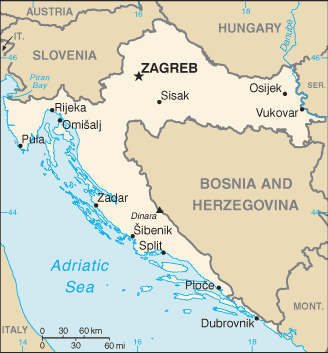
Judicial review of administrative acts and actions is reserved for specialized administrative courts competent to decide on administrative disputes. Administrative courts are established for the territory of one or more counties. There are 4 first instance courts in Republic of Croatia: Administrative court in Split, Administrative court in Zagreb, Administrative court in Rijeka and Administrative court in Osijek. Administrative courts have general competence to settle administrative disputes and there are no specialized administrative tribunals competent to hear specific types of disputes. The High Administrative Court of the Republic of Croatia is established for the territory of the Republic of Croatia.
- B. RULES GOVERNING THE COMPETENT BODIES
- C. INTERNAL ORGANIZATION AND COMPOSITION OF THE COMPETENT BODIES
- D. JUDGES
- 11. Status of judges who review administrative acts
The judges who review administrative acts do not belong to a specific category. The Law on the State Judicial Council sets out the requisites of appointing judges and their rights and duties. According to this law a citizen of the Republic of Croatia having completed the State School for Judicial Officials and work experience in compliance with this Law, may be appointed a judge. There are special conditions that one must fulfil to be appointed as an administrative court judge.
A person having completed the State School for Judicial Officials after the bar exam may be appointed a judge at the administrative court. A person who has worked as judicial official for not less than 12 years may be appointed a judge at the High Administrative Court of the Republic of Croatia. - 12. Recruitment of judges in charge of review of administrative acts
There is no difference between the procedure of the election and appointment for administrative court judges or judges of courts of general jurisdiction. All judges must have a university law degree and have to pass bar exam. After passing the bar exam the initial training of future judges is conducted at the State School for Judicial Officials. - 13. Professional training of judges
According to the Law on Courts judges are bound to continuing professional development and participation in educational and training programmes at the Judicial Academy. In-service training of judges is conducted by the Judicial Academy and its five regional centres. It comprises activities of standard type training intended for the entire or for most of the judicial service corpus and specialist programs intended only for judges dealing with specific issues. - 14. Promotion of judges
The judge can be promoted in higher judicial rang (district court, high specialized court, supreme court judge). - 15. Professional mobility of judges
A judge can not be transferred against his/her will except in the case the court is abolished or reorganized. A judge can not hold an office or perform work defined by law as being incompatible with his/her judicial office.
A judge may, with his or her consent, be temporarily assigned to work in another court for a period of up to four years, with the possibility of extending this period for another four years.
A judge may be temporarily assigned to work in another court when there is a need for a judge in that court, due to an increased caseload or prolonged absence from work of judges who perform judicial duties in that court.
The decision to assign a judge to another court is made by the State Judicial Council upon the proposal of the president of the court to which the judge is assigned, and with the prior opinion of the president of the court where the judge performs judicial duties, and the opinion of the president of the Supreme Court.
If a judge is appointed to be the Minister of Justice, State Secretary or Head of Directorate in the Ministry of Justice or to be a judge in an international court or some other service in international courts and international missions, his/her position as a judge stays in rest while he/she is performing those duties. A judge can with his/her consent be appointed to work in other job positions in the Ministry of Justice, but no longer than four years, during which time his/her position as a judge stays in rest.
- E. ROLE OF THE COMPETENT BODIES
- 16. Available kinds of recourse against administrative acts
The Law on Administrative Disputes implements the system of full review. The court shall nullify an unlawful decision of the body of public law and resolve the matter itself, except where it may not do that in view of the nature of things or where the defendant acted according to its discretion. It can declare a decision of the body of public law null and void. Where the court establishes that the body of public law did not adopt a decision within the prescribed time limit within which it should have issued it, it shall resolve the matter itself, except where it may not do that in view of the nature of things or where the defendant acted according to its discretion. In such a case, the court shall order the defendant to adopt the decision and set a reasonable time limit within which to do so. Where the court establishes that the defendant did not act in accordance with the regulations, a decision or administrative contract, it shall order action within a reasonable time limit. The court can declare an administrative contract null and void and it can declare the decision on termination of the administrative contract null and void if it establishes that the body of public law unjustifiably terminated an administrative contract.
As part of the statement of claim, the court shall also decide concerning the compensation of damages and the return of an item. Where the court issues a judgment terminating or declaring an administrative contract null and void, it shall also make a decision on the compensation of damages.
The High Administrative Court shall nullify a first-instance judgment and resolve the matter in a judgement itself, if it establishes that the administrative court committed a substantial violation of court procedure rule, that it established the state of facts incompletely or erroneously, or that it applied the substantive law erroneously. The High Administrative Court shall repeal a general act of the local and regional self-government; legal persons vested with public powers and legal persons performing public services or some of its provisions with a judgement if it establishes that it is not in conformity with law or the statute of the body of public law. - 17. Existence of mechanisms for the delivery of a preliminary ruling apart from the procedure under the Article 234 of the EC Treaty
If the decision in an administrative dispute depends entirely or partly on preliminary question (an issue belongs to the competence of another court or body), the court may, discuss it, or it may suspend the procedure until the question has been resolved by the competent body (article 104. LAD).
If a court in its proceedings determines that the law to be applied, or some of its provisions, are not in accordance with the Constitution, it shall suspend the proceeding and present a request with the Constitutional Court to review the constitutionality of the law, or some of its provisions. If the court in its proceedings determines that another regulation to be applied, or some of its provisions, are not in accordance with the Constitution and the law, it shall directly apply the law to that specific case and shall present a request with the Constitutional Court to review the constitutionality and legality of the disputed regulation or some of its provisions.
There is no specific provision concerning preliminary ruling procedure. - 18. Advisory functions of the competent bodies
Administrative courts have only judicial functions in accordance with the constitutional principle of separation of powers. However, in the legislative process, when drafting laws regarding issues falling within the competence of the specific court, the ministry may appoint judges to a specific working group or ask the court to give its suggestions regarding solutions foreseen by the draft law in question. These suggestions are formed at the meeting of the court department or the meeting of all judges of the court, but they do not have binding character. - 19. Organization of the judicial and advisory functions of the competent bodies
See the answer to question no. 18.
- F. ALLOCATION OF DUTIES AND RELATIONSHIP BETWEEN THE COMPETENT BODIES
- II – JUDICIAL REVIEW OF ADMINISTRATIVE ACTS
- A. ACCESS TO JUSTICE
- 21. Preconditions of access to the courts
It is necessary for a claimant to exhaust regular legal remedies in the administrative procedure before going to court. The administrative body of second instance decides on the appeal against a decision, action or administrative contract issued by the administrative body of first instance. If the party who had the opportunity to file a regular legal remedy in the administrative procedure did not file it or had filed it too late, the administrative dispute shall not be permitted. If it is stipulated by law that an appeal against a decision taken by an administrative body of first instance is excluded (single instance procedure), a party may file a claim against the administrative act to the administrative court directly. - 22. Right to bring a case before the court
Parties to the administrative dispute are the claimant, defendant and interested party.
The claimant is a natural or legal person who believes that his rights and legal interests were violated by a decision, by an act of the body of public law, or by the failure to adopt a decision or to act on the part of the body of public law within the time limit fixed by law, or by the conclusion, termination or enforcement of an administrative contract. The claimant may be a person without legal capacity or a group of persons if their rights and legal interests were violated by a decision or an act of a body of public law. The claimant may be a body of public law that participated or should have participated in taking of a decision, performance of an act or conclusion of an administrative contract. The claimant may also be a state body authorized by law.
The defendant is a body of public law that took or failed to take a decision, acted or failed to act or is a party in an administrative contract. An interested party in a dispute is any person to whom the nullification, change or taking of a decision, an act or failure to act by the body of public law, or the conclusion, termination or enforcement of an administrative contract would mean a violation of his right or legal interest. An interested party is also a body of public law that holds that a court decision may have an impact on the rights and legal interests that it protects under law. The interested party may become involved in the dispute at any time. - 23. Admissibility conditions
The claimant is a person who believes that his rights and legal interests were violated by a decision, by an act of the body of public law, or by the failure to adopt a decision or to act on the part of the body of public law within the time limit fixed by law, or by the conclusion, termination or enforcement of an administrative contract. Every claim must include reasons for the initiation of a dispute in respect of the main matter and subsidiary claims and facts and proofs on the basis of which the claimant bases his statement of claim. The court shall establish that there are no conditions for conducting a dispute and dismiss the claim if it establishes that a decision, action or administrative contract does not affect the right or legal interest of the claimant. If the claimant was a party to the administrative procedure in which the administrative act that is being contested in administrative dispute has been issued, he is not required to demonstrate a particular interest in the annulment of this act. - 24. Time limits to apply to the courts
The complaint shall be submitted to the court within 30 days of the service of the disputed individual decision or the decision on the objection against the disputed action. Where an administrative dispute is initiated by reason of a failure to take a decision or act within the fixed time limit, the complaint may be submitted to the court eight days after the expiration of the prescribed time limit at the earliest. Where a decision was not delivered to the party according to the prescribed service rules, a complaint may be submitted within 90 days of the moment the party learned or could have learned about the decision.
It is obligatory for parties to be informed of the time-limits for submitting a complaint in the instructions on legal remedy. If a decision in the instructions on the legal remedy includes a longer time limit than the one prescribed by law, the complaint may be submitted within such longer term. If a decision includes instructions on the legal remedy which states erroneously that a complaint is not permissible, a complaint may be submitted within 90 days of the moment the party learned or could have learned about the possibility of submitting a complaint.
If a party fails to meet a deadline for taking an action in the dispute and therefore loses the right to undertake that action, the court can permit the restoration of a prior status if it deems that there are legitimate reasons for the omission. - 25. Administrative acts excluded from judicial review
Administrative disputes may not be conducted concerning the correctness of an individual decision issued through the application of discretionary decision of the body of public law, but it may be conducted concerning the lawfulness of such a decision, the boundaries of authority and the purposes because of which the authority was granted.
Administrative disputes may not be conducted against a procedural decision of the body of public law, as such a decision may be disputed through a claim against the decision on the main subject-matter, unless provided otherwise by law. - 26. Screening procedures
After receiving a complaint, the administrative court shall examine its jurisdiction, whether the complaint is duly submitted and the existence of conditions precedent for a dispute. If there are no conditions for conducting the court will dismiss the complaint. When the court finds that the complaint is admissible it will schedule a hearing and discuss the case in meritum. If the court establishes that another court is competent for the matter, it shall issue a decision declaring itself non-competent, assign the complaint to a competent court and notify the claimant accordingly.
If a complaint does not include the prescribed parts or if it is not understandable, the complainant shall be asked to correct such defects within a fixed period of time and warned about the consequences of his failure to comply with the instructions of the court. If the complainant fails to correct the defects in the complaint within the set time limit, and the nature of the defects prevents the court from carrying out its work, the court shall dismiss the complaint in a decision as incomplete, unless it finds that the disputed decision is null and void or the administrative contract invalid. An appeal against this decision is permissible.
In the appeal procedure the administrative court shall dismiss an untimely appeal or an appeal submitted by an unauthorized person in a decision within 15 days of its receipt.
If an appeal is unduly submitted, the administrative court shall ask the appellant within 15 days as of the receipt of the appeal to supplement or correct the appeal and set a reasonable time limit for him to do so. If the appellant fails to comply with the order of the court within the time limit, the court shall dismiss the appeal in a decision as unduly submitted. Within eight days, the administrative court shall send a copy of a duly submitted appeal with all related documents to the High Administrative Court for decision- making. The High Administrative Court shall issue a decision dismissing an untimely appeal, an appeal filed by an unauthorized person, or an unduly submitted appeal if the administrative court failed to do so.
The High Administrative Court shall issue a decision dismissing an appeal as impermissible if there are no grounds for filling an appeal stipulated by the Law on Administrative Disputes. - 27. Form of application
There is no specific form required for a claim. Claims must be understandable and include: name of the court to which it is submitted, name, personal identification number and address of the claimant, name of the defendant, reference to the disputed decision or administrative contract or description of the act or obligation of the performance of which is demanded, statement of claim, the scope of disputing the decision, action or administrative contract, reasons for the initiation of a dispute in respect of the main matter and subsidiary claims, facts and proofs on the basis of which the claimant bases his statement of claim, and signature of the claimant. If the return of an item or compensation of damages is demanded in the administrative dispute, the claim regarding items and the amount of damages must be included in the claim. If the claimant does not have residence or registered office in Croatia, he shall designate his power-of-attorney holder or service agent in the claim. The original or copy of the disputed decision, administrative contract or proof of an act must be enclosed to the claim. Where an administrative dispute is initiated by reason of failure to take a decision or act within the fixed time limit, proof of the time of initiation of the administrative procedure or submission of the request to act must be enclosed to the claim. - 28. Possibility of bringing proceedings via information technologies
The Law on Administrative Disputes stipulates that submissions are submitted to the court in written or electronic form. Submissions which are submitted electronically should be certified by electronic signature in accordance with law. Any submission filed electronically shall be deemed submitted to the court at the moment when it is recorded on the server for the sending of such messages. Without any delay, the court shall confirm to the sender electronically that is received the submission. Service by electronic means shall be carried out only upon request or subject to an express consent of the party or another participant in the dispute. Service by electronic means shall be considered performed at the moment when the decision or another act of the court is recorded on the server for receiving such messages. - 29. Court fees
Court fees are paid in administrative disputes only if the court rejects or dismisses the claim. Court fees are not paid in administrative disputes concerning pension insurance, health insurance, social security, war veterans and asylum. - 30. Compulsory representation
Representation by a lawyer is facultative at all administrative court instances. Actions in an administrative dispute may be taken by the claimant if he has full legal capacity or within the limits of his legal capacity. Actions in a dispute for the claimant may be taken by persons authorized to represent them, the joint representatives and joint power-of- attorney holders of a group of persons. - 31. Legal aid
The costs of the proceedings and the court fees can be paid through legal aid. The Law on Free Legal Aid defines conditions for access to legal aid and the procedure for obtaining it. - 32. Fine for abusive or unjustified applications
There is no fine prescribed for unjustified applications. However, the party which loses in a dispute shall bear the costs of the dispute in full unless otherwise prescribed by the law. Any party that withdraws its complaint, appeal or any other proposal, as the result of which the other party incurs costs, shall bear the costs of those parties.
The court may issue a fine or a removal from hearing against any person who participates in a dispute and who insults the court, the party or other participants in a submission or at a hearing, or disturbs the work of the court or fails to comply with the instructions of the court for maintaining order.
A party who abuses the rights they are entitled to in a dispute doesn’t have right to reimbursement of the costs of the dispute (article 147. paragraph 8. LAD).
- B. MAIN TRIAL
- 33. Fundamental principles of the main trial
Fundamental principles of the main trial are principle of legality (article 5.), principle of the partys right to be heard (article 6. paragraph 1. and 2. – without opportunity to respond only in cases prescribed by this Act), principle of the oral hearing (article 7. paragraph 1. and 2. – without oral hearing only in cases prescribed by this Act), principle of efficiency (article 8.), principle of assistance to an ignorant party (article 9.).
Those principle are listed in the Law on Administrative Disputes (LAD), so they derive from national law. European Convention of Human Rights is also direct source of implementing law, because conventions and international treaties are sources of law laid down by Constitution. - 34. Judicial impartiality
Reasons for exemption of the judge are listed in Article 15. of LAD, so a judge may not decide and take part in the dispute: if he is a party, legal representative or power-of-attorney holder of the party or if he is in the relationship of co-authorized person or co-obligor with the party; if the party or the legal representative or power-of-attorney holder of the party is related to him by consanguinity in the direct line up to any degree, and collaterally up to the fourth degree or if they are spouses, life partners or related by kin up to the second degree, regardless whether the marriage was dissolved or not; if he is the caretaker, adopted parent or adopted child of the party, his legal representative or power-of-attorney holder; if in the same matter he participated in the taking the decision in the administrative procedure or in the first- instance administrative dispute; if there are other circumstances which bring into question his impartiality. A judge, as soon as he learns of a reason for disqualification, shall terminate any work on the matter and notify the president of court accordingly, who shall then issue a decision on disqualification of the judge and assign another judge to the matter. - 35. Possibility to rely on the new legal arguments in the course of proceedings
In a first instance proceeding the claimant can state facts and supply evidence, because it is prescribed by LAD that parties may propose facts which should be established and evidence which can be used to establish the facts, although the court is not bound by such proposals (article 49. paragraph 4. LAD). In appeal proceedings new facts may not be presented (article 130. paragraph 3. LAD). - 36. Persons allowed to intervene during the main hearing
Besides claimant and defendant, any interested party can intervene (article 17. LAD). An interested party in a dispute is any person to whom the nullification, change or taking of a decision, an act or failure to act by the body of public law, or the conclusion, termination or enforcement of an administrative contract would mean a violation of his right or legal interest (article 20. LAD). An interested party is also a body of public law that holds that a court decision may have an impact on the rights and legal interests that it protects under law. - 37. Existence and role of the representative of the State (“ministère public”) in administrative cases
Parties in an administrative dispute may, due to particularly serious material or procedural violations of the law that call into question the uniform application of the law and the equality of all in its application propose to the State Attorney’s Office of the Republic of Croatia to file a request for extraordinary review of legality of final judgment of the administrative court or the High Administrative Court. A proposal for extraordinary review of legality of final judgment may be submitted by a party to the State Attorney’s Office of the Republic of Croatia within 60 days from the day the final judgment is serviced to the party. The State Attorney's Office of the Republic of Croatia may submit a request for an extraordinary review of legality to the Supreme Court of the Republic of Croatia within six months from the date of delivery of the final judgment or decision to the parties. The State Attorney’s Office of the Republic of Croatia may also file the request in the line of duty. - 38. Existence of an institution or a person with a role analogous to the French "Commissaire du gouvernement"
Croatian LAD does not prescribe such an institution or a person. - 39. Termination of court proceedings before the final judgment
Where a claim is withdrawn, the court shall issue a decision discontinuing the dispute (article 101. paragraph 3. LAD). If the defendant recognises the statement of claim in full in his response to a claim or during the dispute, the court shall issue a judgment resolving the dispute (article 102. paragraph 1. LAD). The court shall issue a decision discontinuing a dispute where the claimant dies or ceases to exist in disputes which can not be continued due to the nature of administrative matter (article 106. paragraph 1. LAD). - 40. Role of the court registry in serving procedural documents
The court shall deliver the claim and all attachments thereto to the defendant and to any interested parties for their response to a claim (article 48. paragraph 1. LAD). - 41. Duty to provide evidence
The parties and the court are both responsible for providing the evidence. In the claim and in the response to claim, parties shall present all facts on which they establish their claims, propose evidence for establishing such facts and declare themselves about the factual allegations and evidentiary proposals of other parties (article 51. paragraph 1. LAD). The court may request a party to provide statements regarding certain issues relating to the facts of the case and to propose evidence supporting its claims. For that purpose, the court may set a reasonable time limit (article 51. paragraph 2. LAD). The court may request the party to supplement and explain its submissions within a reasonable time limit, and to submit documents and other evidence which might be used in the dispute. The public authorities shall submit documents in their possession upon the request of the court (article 61. paragraph 1. LAD). The public authorities shall designate which documents or parts of documents are considered to be a secret under the laws on the protection and confidentiality of data, and parties may not have access to such data (article 61. paragraph 2. LAD). - 42. Form of the hearing
Hearings are public (article 90. paragraph 1. LAD). The court may prohibit the public from attending an entire hearing or a part thereof if that is necessary in view of the protection of privacy, protection of data and other reasons prescribed by law (article 90. paragraph 2. LAD). Such closing of a hearing to the public shall be issued through a decision (article 90. paragraph 3. LAD). Where a party or any other person participating in a dispute fails to appear at a hearing without having provided an excuse, the hearing may be held without their attendance (article 91. paragraph 3. LAD). - 43. Judicial deliberation
The court shall adopt the judgment according to its discretion and on the basis of an evaluation of all legal and factual issues (article 114. paragraph 3. LAD).
The judge council shall render the judgment by a majority vote. Deliberation and voting shall be recorded in special court minutes which must be signed by all members of the council and the court minute-taker.
At the request of the council member who cast a vote, his written explanation of the cast vote shall be attached to the written judgment. This opinion is published in the same way as the judgment (article 115. paragraph 3. LAD).
- C. JUDGMENT
- 44. Grounds for the judgment
It is prescribed by LAD that the court shall adopt the judgment according to its discretion and based on an evaluation of all legal and factual issues (article 114. paragraph 3. LAD). The judgment may be based only on facts and evidence regarding which the parties were provided with an opportunity to declare themselves (article 114. paragraph 4. LAD), so detailed statement of decisive reasons is required, and it should provide understanding how the law provisions are applied on that individual case. In the explanation of the judgment, the court shall present claims of the parties, facts they presented and evidence they proposed, facts established by the court, why and when they were established, and if they were established through the evidentiary procedure, the evidence presented and assessed. The court shall in particular state the provisions of substantive law applied in deciding about the dispute and declare itself regarding proposals and objections of the parties about which it did not present any reasons during the dispute (article 119. paragraph 5. LAD). In the reasoned explanation of a judgment, the High Administrative Court shall assess the statements of appeal which have decisive character and state the reasons taken into consideration in adopting the decision (article 136. paragraph 5. LAD). - 45. Applicable national and international legal norms
Most often used reference norms are from national law (very large scope of material laws and bylaws, and in procedural sense LAD), and Constitution norms and norms of the European Convention of Human Rights and Fundemental Freedoms. - 46. Criteria and methods of judicial review
The scope of administrative dispute is prescribed in article 3. LAD (paragraph 1. and 2.) and it is the following:
1. assessment of the lawfulness of a decision by which the body of public law adjudicated on a right and obligation in an administrative matter (administrative act) against which it is not permissible to file a regular legal remedy and the adjudication on the rights, obligations and legal interests of the party;
2. assessment of the lawfulness of an act of the body of public law by which a right, obligation and legal interest of the party was breached against which it is not permissible to file a regular legal remedy;
3. assessment of the lawfulness of a failure of the body of public law to adjudicate on a request or a regular legal remedy of the party or to act in accordance with subordinate legislation within the time limit fixed by law as well as the adjudication on the rights, obligations and legal interests of the party;
4. assessment of the lawfulness of the conclusion, termination and enforcement of administrative contracts.
The subject-matter of an administrative dispute is assessment of the lawfulness of a general act of the local and regional self-government legal persons vested with public powers and legal persons performing public services (hereinafter the "general act").
The grounds for appeal against the judgment are prescribed in article 126. LAD which says:
(1) Parties may file an appeal against a particular judgment of the administrative court on the following grounds:
1. a substantial violation of court procedure rules,
2. erroneously or incompletely established state of facts in the dispute, or
3. erroneous application of the substantive law.
(2) An appeal may be filed only when the administrative court decided itself in a judgment over the rights, obligations or legal interests of the party
(3) A substantial violation of court procedure rules exists when the administrative court did not apply or incorrectly applied the provisions of this Act during a particular dispute, which had an effect on the adoption of a lawful and correct judgment.
(4) An erroneously or incompletely established state of facts exists when the administrative court established erroneously or did not establish a decisive fact or has drawn false conclusion about the state of facts.
(5) Erroneous application of the substantive law exists when the administrative court failed to apply a substantive law provision it was supposed to apply or if the court erroneously applied such provision. - 47. Distribution of legal costs
Legal costs are prescribed in article 147. LAD according to which the party who loses the dispute in its entirety bears all the costs of the dispute, unless otherwise provided by law (paragraph 1.).
If a party is partially successful in the dispute, the court may, in view of the success achieved, order that each party bear its own costs or that the costs be distributed in proportion to the success in the dispute (article 147. paragraph 2. LAD)
The court may decide that one party shall reimburse all costs incurred by the opposing party if the opposing party has only been unsuccessful in a relatively minor part of its claim, and no special costs have been incurred due to that part (article 147. paragraph 3. LAD).
A party shall be obliged, regardless of the outcome of the dispute, to reimburse the opposing party for costs incurred through its own fault or as a result of an event that has occurred to it (article 147. paragraph 4. LAD).
A party that has withdrawn a claim, appeal or other proposal that has caused costs to other parties shall also bear the costs of those parties (article 147. paragraph 5. LAD).
If the dispute is discontinued after the defendant has acted upon the claim, the claimant shall be entitled to reimbursement of the costs of the dispute (article 147. paragraph 6. LAD).
A party that abuses the rights it is entitled to in the dispute shall not be entitled to reimbursement of costs (article 147. paragraph 8. LAD). - 48. Composition of the court (single judge or a panel)
At first instance administrative court shall adjudicate in the form of a single judge (article 14. paragraph 1. LAD. When the complexity of the case is required, the judge to whom the case is assigned to can take a decision in a panel of three judges (article 14. paragraph 2. LAD). The judge whom the case was assigned is the president of the panel (article 14. paragraph 3. LAD).
The High Administrative Court shall adjudicate in a three-judge panel, other than concerning the lawfulness of general acts when it shall adjudicate in a five- judge panel (paragraph 4. article 14. LAD). - 49. Dissenting opinions
There can be dissenting opinions because judge council shall render the judgment by a majority vote. Deliberation and voting shall be recorded in special court minutes which must be signed by all members of the council and the court minute- taker, so dissenting opinion is only revealed in the court voting minutes. At the request of the council member who cast a vote, his written explanation of the cast vote shall be attached to the written judgment. This opinion is published in the same way as the judgment (article 115. paragraph 3. LAD). - 50. Public pronouncement and notification of the judgment
In article 121. LAD is prescribed that:
(1) Judgments shall be announced within a period that may not exceed 30 days from the date of conclusion of the hearing.
(2) Judgements shall be announced by the single judge or president of panel.
(3) The judge shall publicly read the dispositive part and provide a reasoned explanation of the judgment in short.
(4) The date of publication of the judgment will be set at the hearing where the hearing was concluded.
(5) The hearing at which the judgment is announced will be held regardless of whether the parties have been properly informed about it or whether they have attended the hearing.
(6) If the public was excluded from the hearing, the judgment will be read publicly, and the court will decide whether and to what extent the public will be excluded before announcing the reasons for the judgment.
(7) All those present will listen to the reading of the sentence while standing.
- D. EFFECTS AND EXECUTION OF JUDGMENT
- 51. Authority of the judgment. Res judicata, stare decisis
Final judgments of the court become res judicata and produce effects only for the parties (inter partes).
The solution given is formally limited to the present case. In practice, however, the courts try to rule on similar legal situations in the same way due to the principle of legal certainty.
Final judgment of the court concerning the lawfulness of a general act shall be binding inter alia (article 10. paragraph 2. LAD). - 52. Powers of the court in limiting the effects of judgment in time
The judgement rendered by the court has an unlimited effect in time. - 53. Right to the execution of judgment
In article 150 paragraph 1. and 2. LAD is prescribed that judgment may be enforced after it is delivered to the party, if a different time limit is not determined in the judgment. Decisions may be enforced immediately after announcement or delivery to the party, unless provided otherwise.
In article 151. LAD is prescribed that the defendant or the body competent for enforcement is obliged to ensure the enforcement of the judgment.
In enforcing the judgment, the defendant or the body competent for enforcement is obliged to act in accordance with the operative part of the judgment, no later than 60 days from the delivery of the final judgment and the return of the file to the defendant if the file is kept in physical form, and is bound by the legal understanding and observations of the court. If the defendant or the body responsible for enforcement of the judgment fails to issue a new decision within the period specified in the judgment or issues a decision that is contrary to the operative part of the judgment, the legal understanding or the court's observations, the claimant may file a request for enforcement of the judgment with the court that issued the judgment. If the judgment ordered payment, enforcement shall be carried out in enforcement proceedings before the competent body (article 152. paragraph 1. LAD).
If the defendant or the body competent for enforcement without justified reasons fails to issue a new decision within the period specified in the judgment or fails to submit a response to the request for enforcement to the court within 15 days, the court shall impose a fine on the head of the competent public law body in a decision in the amount of up to 30% of the average annual gross salary earned in the Republic of Croatia in the previous year (article 154. paragraph 1. LAD).
The court shall impose further fines within the established range until the defendant or the body competent for enforcement issues a new decision in the enforcement of the judgment. (article 154. paragraph 2. LAD)
If the defendant or the body competent for enforcement in the execution of a judgment issues a new decision that is contrary to the operative part of the judgment, the legal understanding or the court's observations, the court shall, after receiving the response to the request for enforcement or the expiry of the deadline for submitting the response to the request for enforcement, by a judgment without holding a hearing, annul the decision that was issued contrary to the operative part of the judgment, the legal understanding or the court's observations and order the defendant or the body competent for enforcement to enforce the judgment within a specified period (article 155. paragraph 1. LAD). - 54. Recent efforts to reduce the length of court proceedings
Protection of right to trial within a reasonable time is prescribed in Croatian Constitution (article 29. paragraph 1.). Policy to reduce the length of time needed to resolve cases is implemented in a way that it is required that administrative procedure should not last more than three years from the filing of the appeal in the administrative procedure even in the most complicated cases.
- E. REMEDIES
- 55. Sharing out of competencies between the lower courts and the supreme courts
The jurisdiction is determined by article 12. LAD Administrative disputes shall be settled by administrative courts and the High Administrative Court of the Republic of Croatia. Administrative courts shall decide on claims against individual decisions of the public authorities; claims against an act of the public authorities; claims against a failure to issue a decision or to act on the part of the body of public law within the time limit fixed by law; claims against administrative contracts and the enforcement of administrative contracts; and in other cases laid down by law. The High Administrative Court shall decide on appeals against the judgments of administrative courts and decisions against which an appeal is allowed; lawfulness of general acts; conflict of jurisdiction between administrative courts and in other cases laid down by law. - 56. Recourse against judgments
In article 126. paragraph 1. LAD it is prescribed that parties may file an appeal against a particular judgment of the administrative court on the following grounds: a substantial violation of court procedure rules, erroneously or incompletely established state of facts in the dispute, erroneous application of the substantive law. In article 139. LAD it is prescribed that the Supreme Court of the Republic of Croatia, shall decide on the request for extraordinary examination of legality of final decisions of the administrative court or the High Administrative Court. The request can be submitted because of serious material or procedural violation of the law which challenges the uniform application of the law and the equality of all in its application. If the Supreme Court of the Republic of Croatia adopts the request, it may annul the judgment and remand the case for a new decision or reverse the judgment.
- F. EMERGENCY AND SUMMARY PROCEEDINGS / APPLICATIONS FOR INTERIM RELIEF
- 57. Existence of emergency and/or summary proceedings
Summary proceedings are regulated by article 108. LAD (see question no. 59.) Emergency proceedings in which the periods for issuing a court ruling is shorter than usually in administrative disputes is for example in Asylum Act, public procurement. - 58. Requests eligible for the emergency and/or summary proceedings
In article 42. paragraph 1. LAD it is prescribed that no lawsuit shall have delayed effect, unless provided otherwise by law. The court may decide that a lawsuit should have delayed effect if the enforcement of a decision or administrative contract would cause damage to the claimant that would be difficult to redress, unless provided by law that a lawsuit shall not delay the enforcement of a decision, and that such a delay is not contrary to public interest.
In article 42. paragraph 3. LAD it is prescribed that the court may issue an interim measure upon the proposal of a party if that is necessary to avoid damages on the part of the claimant which would be difficult to redress, and that such a delay is not contrary to public interest, nor would it cause greater irreparable damage to the opposing party. Kinds of interim measures are not specified by provisions of LAD. It should depend on proposal of a party and aim of that interim measure, so judge intervention is not only conservatory, but it can also protect party from the threat of misconduct and irreparable damages. The court shall decide on an interim measure in a decision. An appeal may be filed against the decision on the interim measure. - 59. Kinds of summary proceedings
Regarding summary proceedings in article 108. LAD is prescribed that where in five or more first-instance disputes at the same court the merit of the claim is of the same legal and factual nature, the court may decide in a judgment which case will be resolved in a model dispute. In other matters, the court shall issue a decision suspending the dispute. After the judgment issued in the model dispute becomes final, the court shall continue to conduct the suspended disputes, and apply the evidence presented in the model dispute. Pursuant to a final judgment adopted in the model dispute, the court may also resolve a dispute initiated after the judgment became final without holding a hearing, and after the parties are provided with an opportunity to provide statements regarding the matter.
In article 107. LAD is prescribed that if one or more claimants initiate two or more disputes before the same court against the same defendant to assess the legality of individual decisions, failure to adopt an individual decision, conduct or administrative agreement, which are based on the same factual and legal basis, these disputes may be joined by a decision ex officio or at the proposal of a party for the purpose of joint deliberation. After the conclusion of the deliberation, the joined cases may be separated for the purpose of making separate judgments.
If several claimants initiate a dispute to assess the legality of the same individual decision, failure to adopt an individual decision, the same conduct or the same administrative agreement, these disputes shall be joined by a decision ex officio or at the proposal of a party for the purpose of joint deliberation and making a joint judgment (paragraph 2. article 107.LAD).
The court may issue a joint judgment for all joined disputes.
- III – NON-JUDICIAL SETTLEMENT OF ADMINISTRATIVE DISPUTES
- IV – ADMINISTRATION OF JUSTICE AND STATISTIC DATA
- A. FINANCIAL RESOURCES MADE AVAILABLE FOR THE REVIEW OF ADMINISTRATIVE ACTS
- B. OTHER STATISTICS
- 70. Number of new applications registered every year
Administrative courts:
2023. - 15998
2024. - 14896
The High Administrative Court of the Republic of Croatia:
2023. - 4773
2024. - 5194 - 71. Number of cases heard every year by the courts or other competent bodies
Administrative courts:
2023. - 15998
2024. - 14896
The High Administrative Court of the Republic of Croatia:
2023. - 4773
2024. - 5194 - 72. Number of pending cases
Administrative courts:
2023. - 8408
2024. - 9873
The High Administrative Court of the Republic of Croatia:
2023. - 2749
2024. - 2947 - 73. Average time taken between the lodging of a claim and a judgment
Administrative courts:
2023. - 4 months/2 days
2024. - 5 months/10 days
The High Administrative Court of the Republic of Croatia:
2023. - 6 months/11 days
2024. - 5 months/27 days - 74. Percentage and rate of the annulment of administrative acts decisions by the lower courts
The High Administrative Court of the Republic of Croatia (when it is competent as the first instance court):
2023. - 13,2%
2024. - 5,6% - 75. The volume of litigation per field
Administrative courts:
2023.
1.general administrative matter (citizenship, asylum,foreigners etc.) - 3139
2. property law - 576
3. building law - 1890
4. social security law - 249
5. war veterans - 668
6. financial law(taxes, duties) - 1203
7. labour law - 538
2024.
1. general administrative matter (citizenship, asylum,foreigners etc.) - 2719
2. property law - 459
3. building law - 1887
4. social security law - 204
5. war veterans - 399
6. financial law (taxes, duties) - 930
7. labour law - 433
The High Administrative Court of the Republic of Croatia:
2023.
1. general administrative matter (citizenship, asylum,foreigners etc.) - 76
2. property law - 259
3. building law - 720
4. social security law - 49
5. war veterans - 176
6. financial law (taxes, duties) - 551
7. labour law - 276
2024.
1. general administrative matter (citizenship, asylum,foreigners etc.) - 141
2. property law - 267
3. building law - 946
4. social security law - 58
5. war veterans - 430
6. financial law (taxes, duties) - 476
7. labour law - 220
- C. ECONOMICS OF ADMINISTRATIVE JUSTICE
|